The Cabinet IQ franchise is not your typical home services concept, and that becomes clear the moment you understand what it actually solves. Most homeowners embarking on a kitchen remodel face the same frustrating reality: fragmented vendors, poor communication, delayed timelines, and no single point of accountability.
Cabinet IQ was built specifically to fix that, combining a showroom-led sales experience with a technology-driven process that manages the project from design through installation under one brand.
This review covers what it costs to open a Cabinet IQ franchise, how the business model works day to day, what training and support the franchisor provides, and which candidates are most likely to be a strong fit. It draws from the 2025 Franchise Disclosure Document, official brand materials, and publicly available information.
This article is sponsored by Cabinet IQ and was created in partnership with the brand to provide accurate, compliance-safe information about its business model and franchise opportunity. Nothing in this article should be considered legal, financial, or tax advice.
Prospective franchisees should always review the most recent Franchise Disclosure Document (FDD) with qualified advisors before making an investment decision.
Key Facts at a Glance.
- Founded: Affiliate operating roots date to 2016 as a sole proprietorship; brand formalized in 2018; franchising began January 2022.
- Headquarters: Cedar Park, Texas (Austin metro area).
- Business model: Showroom-based, residential and commercial cabinet and countertop remodeling; franchisees operate from a retail showroom with subcontracted installation.
- Owner profile snapshot: Sales-oriented operators, career changers from B2C sales or home services, or construction-savvy growth operators; no design or construction background required.
- Training highlight: Multi-stage program combining video coursework, in-person training at headquarters in Austin, Texas, and one week of on-site support at the franchisee’s location.
- Territory note: Each franchisee receives a protected territory generally based on up to 100,000 owner-occupied households; candidates may add territories at signing.
Who Owns Cabinet IQ, and How Did the Brand Get Started?
Michael Hartel did not set out to build a cabinet company. He earned a Master’s degree and a Ph.D. in engineering, spent time at a desk job, and eventually made his way into real estate and then general contracting. It was there, on job sites across the Austin area, that he kept running into the same problem — cabinets.
It did not matter whether a homeowner hired a budget supplier or a premium remodeler. Cabinets were almost always the part of the project that caused delays, created confusion, and left customers frustrated. In 2016, Hartel decided to fix it himself. He began ordering cabinets directly, handling installation personally, and learning every step of the process from design through delivery. What started as a solution for his own work quickly became something neighbors and strangers were calling about too.
That business became Cabinet IQ — a concept built on the belief that homeowners deserve one accountable team guiding them from cabinet selection through finished installation, with clear communication and no dropped handoffs. The showroom was a deliberate design choice, because Hartel understood that customers making five-figure decisions need to see and touch real products before they commit.
Cabinet IQ began franchising in 2022, bringing the same systems, supplier relationships, and technology platform proven in its Austin-area locations to franchise owners across the country. Today Hartel continues to lead the brand, and his path from engineer to contractor to franchisor is reflected in the operational discipline at the core of everything Cabinet IQ does.
How Much Does It Cost to Open a Cabinet IQ Franchise?
Opening a Cabinet IQ franchise requires a brick-and-mortar retail investment that, based on current disclosure materials, ranges from approximately $298,350 to $454,750 for a base territory with a single showroom.
That range reflects variability in real estate, showroom build-out, and local market conditions. Candidates who add a second territory at signing can expect a total investment ranging from approximately $349,950 to $506,350.
The table below breaks the base territory investment into its main components so candidates can begin building a planning baseline.
Cabinet IQ Franchise: Startup Costs & Fees.
| Type of Expenditure | Low* | High* |
|---|---|---|
| Initial Franchise Fee | $53,550 | $59,500 |
| Custom Marketing & Services Activation Fee | $2,000 | $2,000 |
| Showroom Design and Order Preparation Fee | $3,000 | $3,000 |
| Software Implementation Assistance Fee | $2,500 | $2,500 |
| Rent | $10,000 | $18,000 |
| Lease, Utility, and Security Deposits | $6,300 | $10,500 |
| Exterior Signage | $5,000 | $8,000 |
| Improvements | $176,000 | $255,000 |
| Construction Management | $0 | $36,000 |
| Travel Expense to Training | $500 | $3,000 |
| Insurance | $1,500 | $3,500 |
| Grand Opening Advertising / Marketing (Lead Generation) | $18,000 | $18,000 |
| Professional Fees | $1,000 | $5,000 |
| Office Supplies and Promotional Items | $500 | $1,250 |
| Technology, Computer, and Software | $3,500 | $3,500 |
| Business Licenses and Permits | $0 | $1,000 |
| Additional Funds – 3 Months | $15,000 | $25,000 |
| TOTAL ESTIMATED INITIAL INVESTMENT | $298,350 | $454,750 |
The largest variable cost in the range is the showroom build-out and display inventory, which depends heavily on the condition of the leased space and the cabinet display packages ordered. The franchisor has negotiated supplier pricing that helps offset display costs meaningfully compared to what an independent cabinet retailer would pay.
Important context: These figures reflect startup and early operating needs only. They do not indicate financial performance or outcomes.

Ongoing Fees & System Contributions.
| Category | Amount* | Notes |
|---|---|---|
| Royalty Fee* | 6% of Gross Sales* | Due by the 5th of each month for prior month’s Gross Sales. Minimum royalty kicks in at month 13: $2,500/month, rising to $3,750 at month 25 and $5,000 at month 37. |
| Brand Fund Contribution* | Currently 1% of Gross Sales; up to 2% maximum* | Paid to the franchisor monthly alongside the royalty fee. |
| Local Marketing Spend* | Greater of 4% of Gross Sales or $4,500/month minimum per showroom* | Begins 30 days before the in-person training. A second territory adds a minimum of $1,000/month. All advertising must be pre-approved. |
| Technology Fee* | $499 per month per showroom* | Covers Cabinet IQ Smart CRM, Learning Center, Qvinci financial reporting, and design portal upkeep. |
| Software Expenses* | Approximately $2,295/year plus $90/month and $75/month* | Includes Design 2020 software, QuickBooks Online, and QuickBooks Payroll; paid to third-party providers. |
| Bookkeeping / Accounting Service* | $445 to $615 per month* | Required designated vendor; rate is based on Gross Sales level. |
| Computer Lease* | $150 per month* | Must use designated vendor; includes laptop lease, security software, online backup, MS Exchange email, Office 365, and unlimited remote support. |
What Tends to Move the Total Up or Down?
The total investment for a Cabinet IQ franchise moves primarily with real estate, showroom display choices, and how aggressively the owner funds early local marketing. Candidates who find favorable second-generation retail space and lean into the franchisor’s negotiated display pricing tend to land closer to the lower end of the range.
Key cost drivers include:
- Real estate and lease terms: Showroom location, landlord improvement allowances, and local market rental rates are the single biggest variables in the startup range.
- Showroom build-out scope: The condition of the space at lease signing, from raw construction to move-in ready, can shift build-out costs significantly.
- Display and materials: Cabinet IQ has negotiated supplier pricing that reduces display costs substantially; taking advantage of those terms helps compress initial investment.
- Technology and software stack: Required systems include CRM, design software, financial reporting, and accounting tools; some of these have fixed monthly costs that begin before revenue ramps.
- Local marketing investment: The required local marketing spend begins pre-opening, so candidates should budget for marketing activity before the first project closes.
- Working capital cushion: Owners who build a conservative cash buffer for the first three months of operation tend to handle early ramp-up more comfortably.
What Is Cabinet IQ’s Business Model, and What Do Day-to-Day Operations Look Like?
Cabinet IQ operates a showroom-based, design-to-installation kitchen and bath remodeling business focused specifically on cabinets and countertops. The concept is deliberately narrower than a full-service remodeling company, which allows franchisees to develop real expertise in a high-ticket, repeat-referral category without trying to manage an entire renovation.
The business model works through a retail showroom where homeowners come to see real cabinet samples, compare finishes and styles, and work through design decisions with a knowledgeable salesperson. Once a project is sold, the franchisor’s technology platform manages the communication, scheduling, and collaboration between the franchisee, the customer, and the installation subcontractors through to completion. Installations are carried out by vetted subcontractors rather than in-house crews, which keeps the staffing model lean and flexible.
Revenue comes from residential and some commercial projects, with ticket sizes that reflect the premium nature of full cabinet and countertop remodeling. The business supports both an owner-operator model where the franchisee drives sales and operations personally and a semi-absentee structure where a General Manager leads daily execution under the franchisee’s oversight.
What Does a Typical Day Look Like for an Owner-Operator?
For a Cabinet IQ owner-operator, a typical day moves between the showroom, the field, and the administrative layer of the business. The role rewards people who are comfortable in front of customers, disciplined about following up on leads, and organized enough to manage multiple active projects at once.
Common daily responsibilities include:
- Showroom sales and customer consultations: Meeting with homeowners to walk through cabinet styles, countertop options, and design layouts, guiding the decision process toward a signed project agreement.
- Field visits and measurements: Traveling to customer homes to collect measurements, assess existing conditions, and set realistic project expectations before design is finalized.
- Subcontractor coordination: Communicating with installation crews to confirm scheduling, address any on-site issues, and maintain the brand’s 2-day job completion standard wherever possible.
- CRM and lead management: Opening the system each morning to review incoming leads, follow up on proposals in progress, and track the pipeline from first contact through project close.
- Scorecard and performance review: Monitoring operational metrics and financial dashboards to make short- and long-term business decisions based on real data rather than intuition.
- Local marketing execution: Coordinating approved outreach campaigns, attending community events, and managing relationships with contractors and interior designers in the territory.
What Training, Support, and Technology Does the Franchisor Provide?
Cabinet IQ provides a structured multi-stage support system designed to take franchisees from pre-opening through steady-state operations with consistent guidance at each step. The training model combines self-paced video learning with in-person instruction at headquarters and a week of dedicated on-site support at the franchisee’s own location.
Support & Systems Overview.
| Support Area | Details |
|---|---|
| Initial Training | Multi-stage program: video courses and quizzes, in-person training at headquarters in Austin, Texas, and one week of on-site support at the franchisee’s location. Total: approximately 98 classroom hours and 40 on-the-job hours. |
| Ongoing Training | Ongoing access to the Cabinet IQ Learning Center; refresher programs and annual conference as designated by the franchisor. |
| Field Support | Periodic on-site visits and ongoing remote support; franchisor may provide additional on-site assistance at franchisee’s request subject to current per diem charges. |
| Manuals / SOPs | Access to the confidential operations manual covering daily operations, marketing, sales, kitchen and bath design, and job site processes. |
| Technology Platform | Cabinet IQ Smart CRM, Qvinci financial reporting, design portal, and required software stack including Design 2020 and QuickBooks. |
| Marketing Support | Corporate call center outreach, cold calling to permit holders, postcard mailers, SEO oversight, Google and Facebook ad management through a third-party agency, and neighbor outreach campaigns around active projects. |
In practice, franchisees can expect:
- A clearly sequenced onboarding path that covers sales, operations, design workflow, and job site standards before opening.
- An in-person training component at Austin headquarters that brings together the Operating Principal, Manager, and Salesperson.
- A full week of on-site support at the franchisee’s own location to help apply training to real local conditions.
- A technology stack that manages CRM, financial reporting, design, and accounting in one connected environment.
- A corporate marketing team that actively supports lead generation through call center outreach, digital advertising, and direct mail programs tied to local permit activity.
What Should You Confirm During Due Diligence?
Due diligence is where a candidate moves from reviewing brand materials to making a grounded ownership decision. For a showroom-based, high-ticket remodeling concept, direct conversations with current franchisees and a careful review of the legal documents are essential.
Key questions to prioritize include:
- How is the training program sequenced, and what is expected of each role before the showroom opens?
- What does ongoing field support look like after the opening period — cadence, format, and who leads those visits?
- What are the full technology costs, including monthly fees for CRM, design software, financial reporting, and bookkeeping?
- How are territories defined and measured, and what performance conditions affect protected status?
- What are the renewal and transfer terms, and how have those been applied in practice?
- What assumptions drive the startup investment estimates, and how closely have recent openings tracked those figures?
- Does the current disclosure include financial performance information, and what does it cover?
- Which current and former franchisees are available to speak with, and in which markets?
How Do Territories, Real Estate, and Equipment Requirements Typically Work?
Cabinet IQ is a showroom-based retail concept, so territory structure, real estate selection, and equipment choices are all meaningful decisions that happen early in the process. Each of these areas deserves careful review before signing a franchise agreement.
What Real Estate Profile Is Typical?
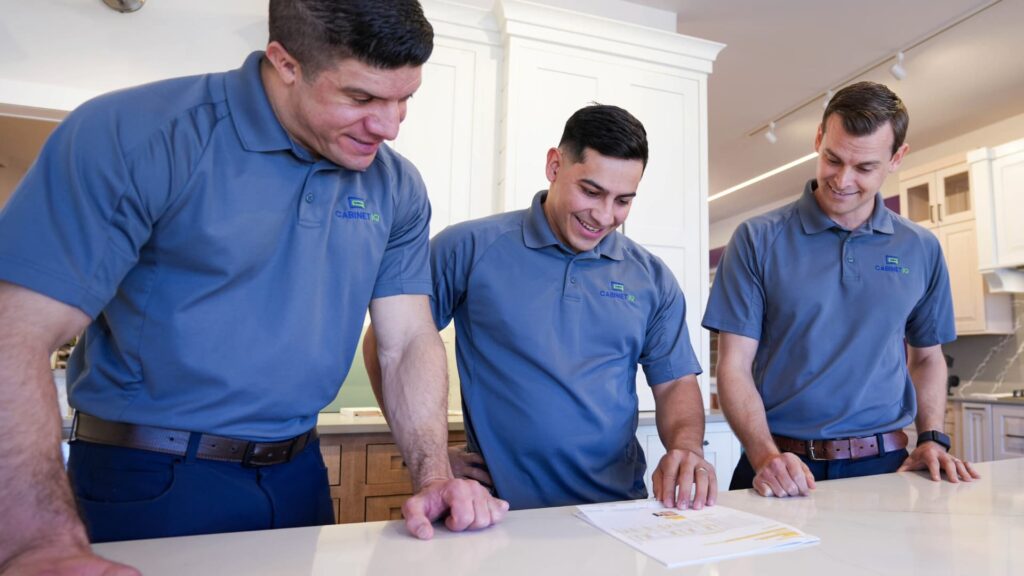
A typical Cabinet IQ showroom occupies approximately 1,800 to 2,000 square feet in a light industrial space or strip shopping center. The franchisor requires that the location include both a retail showroom and an office area, and up to two contiguous territories may share a single showroom.
The showroom is not just an operational space — it is a core part of the sales process. Homeowners visit to see real cabinet samples, compare finishes and door styles, and work through design decisions in person. Cabinet IQ partners with a real estate firm to help identify suitable commercial properties, and the franchisor reviews and must approve the location before a lease is signed.
Because rental rates vary significantly by market, candidates should investigate local lease costs early in the evaluation process. The franchisor’s site criteria consider factors such as space condition, layout, visibility, and proximity to the target residential market.
How Does Territory Protection Work?
Each Cabinet IQ franchisee receives a protected territory generally covering up to 100,000 owner-occupied households. A protected territory in franchise terms means the franchisor agrees not to grant another franchisee or operate a competing same-brand location within that defined area, as long as the franchisee remains in good standing and meets the obligations of the franchise agreement.
Territorial protection can be lost if a franchisee defaults on the franchise agreement, fails to maintain sufficient staffing or equipment, or otherwise fails to meet the system’s operational requirements. Once lost, protected status cannot be regained.
Candidates who want to expand from day one can purchase one additional territory at signing, which adds $47,600 to the initial franchise fee and increases the total estimated investment to between $349,950 and $506,350.
During discovery, candidates should confirm:
- How territory boundaries are defined and mapped, whether by zip code, census data, or other methods.
- What specific performance obligations are tied to maintaining protected status.
- How the revenue-sharing program between franchisees works for projects that cross territorial lines.
What Equipment or Vehicles Are Commonly Required?
Cabinet IQ is a showroom-based model, so vehicles are currently optional rather than mandatory. However, if a vehicle is used in the operation of the franchise, it must meet the franchisor’s appearance and brand standards.
Core equipment and technology requirements include:
- Showroom displays: Cabinet and countertop samples installed in the showroom; the franchisor has negotiated supplier pricing that significantly reduces display costs.
- Office technology: Required laptop, monitors, printer and scanner, and smartphone that meet the franchisor’s minimum specifications.
- Software stack: Design 2020 software for kitchen design, QuickBooks Online for accounting and payroll, and CRM software designated by the franchisor.
- Security and smart systems: Security cameras, speakers, and a smart TV for use at the showroom premises.
- Communication systems: Internet and telecommunications equipment meeting the franchisor’s standards for electronic reporting.
Candidates should request the current required-equipment list during discovery and confirm approved vendors, replacement expectations, and any optional upgrades recommended by the franchisor.
Who Is the Ideal Cabinet IQ Owner, and What Time Commitment Is Typical?
The ideal Cabinet IQ franchise owner is a sales-oriented operator who brings strong interpersonal skills, process discipline, and a willingness to lead both a customer-facing showroom and a subcontractor-dependent installation model. No prior design or construction background is required, but a genuine comfort with consultative selling and team leadership is essential.
Cabinet IQ offers two ownership structures. The owner-operator model requires direct daily involvement in either sales and design or operations and administration. The semi-absentee model allows a franchisee to hire a strong General Manager to oversee daily execution while the owner focuses on high-level oversight, but meaningful involvement is still expected.
Key fit factors include:
- Sales management experience: The showroom model lives and dies by pipeline discipline, lead follow-up, and the ability to close premium-ticket projects through consultative selling.
- Comfort following systems and processes: Cabinet IQ uses a defined technology stack, required suppliers, and standardized operating procedures; owners need to respect and execute those consistently.
- Customer service orientation: The brand’s reputation is built on 5-star service in a category where poor communication is the norm; owners must genuinely care about the customer experience.
- Community outreach and networking comfort: Building relationships with contractors, interior designers, and real estate professionals in the territory is a meaningful part of driving project volume.
- Operational discipline and attention to detail: Managing subcontractors, material deliveries, and active job timelines requires owners who track details and solve problems proactively.
- Time commitment: Owner-operators should plan for full-time involvement, particularly during the launch and early growth period; semi-absentee structures require a qualified General Manager approved by the franchisor.
How Does Cabinet IQ Compare to Similar Franchise Options?
Cabinet IQ occupies a specific and largely uncontested position within the home services franchise category. Most remodeling franchises focus on full kitchen renovations or cabinet refacing rather than new cabinet and countertop installation specifically. Cabinet IQ’s narrower focus allows franchisees to build genuine expertise in a high-ticket category without the complexity of managing an entire renovation project.
Relative to similar home services and remodeling franchise options, Cabinet IQ stands out in several ways:
- Core service focus: A cabinet-and-countertop-only model rather than a broad remodeling menu; the specialization supports stronger design expertise and a more focused sales conversation.
- Showroom model: A physical retail environment that elevates the sales process and supports premium project pricing; not all home services franchises require or include a showroom.
- Operational complexity: A subcontracted installation model keeps the in-house team lean, but requires owners who can vet, manage, and hold subcontractors accountable to brand standards.
- Territory approach: Defined protected territories based on owner-occupied household counts, with the option to add territories at signing.
- Service delivery channel: Brick-and-mortar showroom combined with field-based installation; not mobile, home-based, or purely digital.
- Experience requirements: No design or construction background required; sales management experience and process discipline are valued more than technical credentials.
- Support depth: Corporate call center outreach, permit-based cold calling, SEO management, and direct mail programs provide a more active lead generation infrastructure than many home services concepts offer.
FAQ About the Cabinet IQ Franchise.
What does it cost to get started with a Cabinet IQ franchise?
The total estimated initial investment for a base territory is between $298,350 and $454,750, including the franchise fee, showroom build-out, technology, marketing, and three months of additional operating funds. Candidates who add a second territory at signing should budget between $349,950 and $506,350.
Do I need a background in construction or kitchen design to qualify?
No prior design or construction experience is required. Cabinet IQ is specifically looking for owners with sales management experience, a process-oriented mindset, and the ability to lead a team. The training program covers kitchen design, sales, operations, and job site processes before opening day.
Do I need to be in the business full time?
Cabinet IQ supports both an owner-operator model and a semi-absentee structure. Owner-operators are hands-on daily in sales, design, or operations. Semi-absentee owners must hire a qualified General Manager approved by the franchisor to handle daily execution while the owner oversees the business from a higher level.
Will I have a protected area for my Cabinet IQ business?
Yes. Each franchisee receives a protected territory based on up to 100,000 owner-occupied households. Protection remains in place as long as the franchisee meets the obligations of the franchise agreement. A second territory can be added at signing for an additional $47,600.
Is financial performance information available before I commit?
The franchisor may provide financial performance information in Item 19 of the FDD; consult the document with a qualified advisor.
Is Cabinet IQ the Right Fit for You?
Cabinet IQ may be a strong fit for candidates who are comfortable in a sales-led, showroom-based environment and who want to bring structure and accountability to a home services category that is widely known for poor communication and unreliable execution. It may be less suitable for candidates who prefer a passive investment, a simpler operational model, or a concept with a longer franchising track record.
It may be a good fit if you:
- Have a background in B2C sales, home improvement, real estate, or another performance-driven field.
- Enjoy the consultative selling process and can guide customers through high-ticket decisions with confidence.
- Are comfortable managing subcontractors, tracking active jobs, and holding vendors accountable to brand standards.
- Want a showroom-based model where the physical environment supports premium pricing and customer trust.
- Are looking for a defined territory with an expansion path and a relatively lean staffing model.
- Are prepared for full-time involvement, especially during the launch period and early growth phase.
You may want to be cautious if you:
- Have no sales experience and are uncomfortable leading a customer-facing, high-ticket sales process.
- Prefer a fully passive or semi-absentee structure from day one without building a strong management team first.
- Are uncomfortable managing subcontractor relationships and the accountability that comes with field-based installation work.
- Are looking for a concept with a longer franchising history and a larger base of franchisee validation contacts.
- Want certainty around financial outcomes rather than a disciplined, due-diligence-based investment decision.
A good franchise decision is rarely made in a hurry. If Cabinet IQ feels like a strong fit, the next step is to dig deeper — talk to current owners, review the numbers with qualified advisors, and compare your options with the same discipline you would bring to running the business itself.