For aspiring owners, the key question is whether leading a technically intensive, operations‑heavy, essential service business fits their skills, goals, and tolerance for managing people, inventory, and industrial customers.
This Pirtek Franchise Review explains startup costs, ongoing fees, training and technology requirements, territory and real estate expectations, and the leadership traits Pirtek looks for in its franchisees, drawing on the FDD, official brand materials, and other non‑earnings sources.
This article is sponsored by Pirtek and was created in partnership with the brand to provide accurate, compliance‑safe information about its business model and franchise opportunity. Nothing here is legal, tax, or investment advice, and prospective franchisees should review the most recent Franchise Disclosure Document with qualified advisors before making any investment decision.
Key facts at a glance.
Pirtek is a center-based, B2B service franchise that combines fully equipped mobile service vans with a hydraulic hose service center in each territory. Franchisees serve a broad mix of industrial and commercial customers that depend on working equipment to generate revenue.
- Founded: Pirtek originated in 1980 in Australia and entered the U.S. in 1996.
- Franchisor entity: Pirtek USA LLC, a Delaware limited liability company formed in 1997.
- Headquarters: 300 Gus Hipp Boulevard, Rockledge, Florida 32955.
- System size: 194 franchised Pirtek businesses open in the U.S. at the end of 2025 (Tier 1 and Tier 2 combined).
- Business model: Service-and-supply center plus Mobile Sales and Service Units (MSSUs) for on-site hydraulic hose and related services.
- Estimated total initial investment: $247,013 – $689,614, depending on tier, build-out, and growth plan.*
- Ideal candidate: Leadership-minded, financially savvy, customer‑centric operators comfortable leading a technical team and B2B relationships; prior hose or mechanical experience is not required.
Who owns Pirtek, and how did the brand get started?
Pirtek’s story begins in 1980 in Australia, where the founders set out to bring speed, structure, and reliability to hydraulic and industrial hose service. The model quickly proved itself, and by 1989 the Pirtek System was established in the UK, where it became a leading franchise brand and was named Franchise of the Year.
With success in two mature industrial markets, Pirtek entered the United States in 1996, bringing its mix of mobile service units and service‑and‑supply centers to equipment‑driven industries across the country. In 2000, the system was recognized as International Franchise of the Year, reflecting how far the concept had scaled from its Australian roots.
Pirtek leaders emphasize deliberate growth and carefully chosen markets, with a stated focus on helping centers become prosperous rather than expanding at any cost.
Guided by the mantra “the best service at a competitive price,” the brand has grown to hundreds of centers worldwide, including locations across the U.S., Europe, Africa, and Asia‑Pacific, while refining a franchise format designed to keep centers growing even as other concepts mature.
How much does it cost to open a Pirtek franchise?
Launching a Pirtek franchise requires a substantial investment because the model involves branded mobile units, specialized inventory, technology systems, and, for Tier 1 or later Tier 2 conversion, a physical service-and-supply center.
According to Item 7 of the Pirtek FDD, the total estimated initial investment ranges from $247,013 to $689,614, depending on whether the business is structured as Tier 1 or Tier 2 and on local real estate, build‑out conditions, and working-capital choices.*
The estimate includes the initial franchise fee, technology start‑up, required product inventory and branded items, MSSU vehicle wraps, shop equipment, training and travel, insurance, deposits, and five months of additional funds for operating expenses.
Within that range, Tier 2 mobile‑first owners tend to be nearer the lower end, while Tier 1 owners with full centers, build‑out obligations, and more equipment gravitate toward the higher end.
Pirtek Franchise: Startup Costs & Fees.
| Type of Expenditure | Low* | High* |
|---|---|---|
| Initial Franchise Fee | $59,500 | $59,500 |
| Opening Set-up Fee | $0 | $14,000 |
| Initial Technology Start-up Fee | $8,000 | $10,000 |
| Computer System | $3,000 | $5,000 |
| Training | $2,000 | $15,000 |
| Leasehold Improvements | $0 | $37,000 |
| Marketing Supplies and Signage | $1,273 | $9,033 |
| Shop Equipment | $2,500 | $59,683 |
| Mobile Sales & Service Units (MSSUs) | $0 | $20,000 |
| MSSU Vehicle Wrap | $10,655 | $11,000 |
| Tracking System | $300 | $300 |
| Prepaid Rent and Security Deposit | $700 | $5,000 |
| Opening Inventory | $76,952 | $173,421 |
| Insurance Premiums | $20,000 | $40,000 |
| Utility Deposits and Business Licenses | $400 | $3,000 |
| Attorneys’ Fees | $2,000 | $5,000 |
| Consumables | $700 | $1,400 |
| Shop Supplies & Tools | $4,020 | $8,464 |
| Safety Equipment | $3,813 | $3,813 |
| Freight / Delivery Charges | $1,200 | $9,000 |
| Additional Funds – 5 Months | $50,000 | $200,000 |
| TOTAL ESTIMATED INITIAL INVESTMENT | $247,013 | $689,614 |
Tier 1 vs. Tier 2: In the Pirtek FDD, a Tier 1 business starts with a service-and-supply center plus two MSSUs and typically drives the higher end of the investment range.
A Tier 2 business starts with two MSSUs without a service-and-supply center, which is why it generally aligns more closely with the lower end of the range, but it must later add a third MSSU and open a service-and-supply center within the timelines set out in the franchise agreement.
Ongoing fees and system contributions.
Once operating, Pirtek franchisees pay royalties, marketing contributions, technology fees, and other system-related charges that affect weekly and monthly cash flow. These fees help fund the franchisor’s support infrastructure, marketing initiatives, and technology stack.
Pirtek Ongoing Fees.
| Category | Amount / Basis* |
|---|---|
| Continuing License (Royalty) Fee | 4% of Gross Sales |
| Marketing Fees | 1.5–3% of Gross Sales (2026: 1.5%) |
| Required Local Marketing | 0.75–1.5% of Gross Sales (in addition to Marketing Fees) |
| Technology Fee | $889 – $2,978 per month (licenses and mobile technology) |
| Insurance | Approx. $2,000 – $10,000 annually for liability, plus $4,000 – $30,000+ for other coverages |
| Renewal Fee | $10,000 (CPI‑adjusted over time) |
| Transfer Fee | Greater of $15,000 or 5% of sale price (CPI‑adjusted) |
| Tracking System Services Fee | Approx. up to $100 per van per month |
| Territory Infringement Fee | From gross profit/full invoice amount up to 2–5× invoice for intentional or repeated infringements |
In addition, franchisees must purchase inventory and many non‑inventory items from the franchisor at current prices, and Pirtek estimates that required purchases from it and approved suppliers account for roughly 65–75% of initial build‑out costs and 15–25% of ongoing operating costs.
Candidates should map these obligations into a financial model before committing and can use tools such as the FBA’s franchise financial calculator to stress‑test assumptions before finalizing a funding plan.
What is Pirtek’s business model, and what do day‑to‑day operations look like?
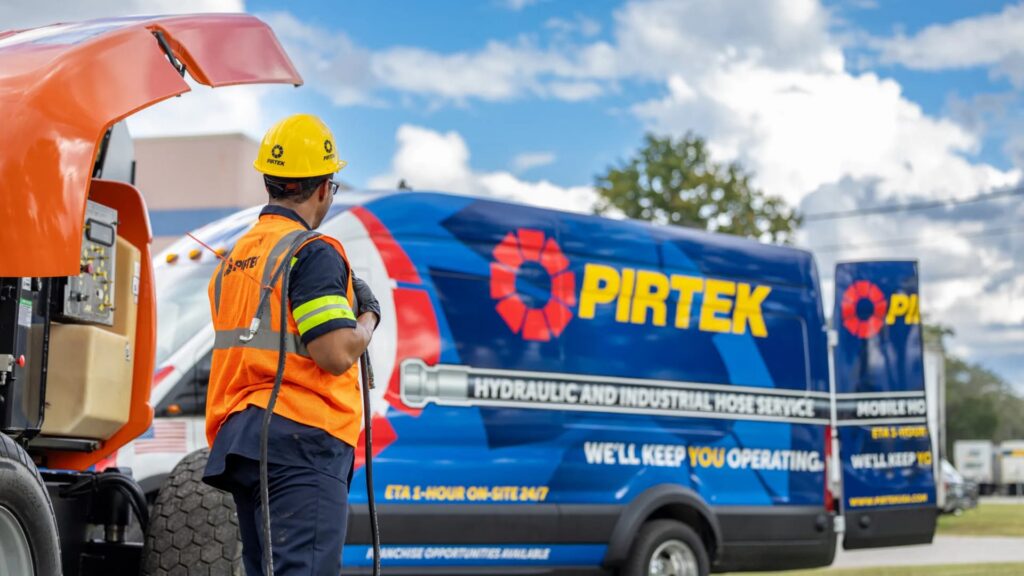
Pirtek’s business model centers on keeping customers’ equipment working by providing fast, on‑site replacement and assembly of hydraulic and industrial hoses, fixed tube assemblies, fittings, and related components. Franchisees operate a service-and-supply center that stocks more than 2,400 product lines and serves as the base for fully branded Mobile Sales and Service Units (MSSUs) that respond to customer calls in the field.
Customers span a wide range of B2B and institutional segments—including construction, civil engineering, manufacturing, transport, agriculture, mining, marine, and government—so demand tends to be driven by equipment uptime rather than consumer sentiment. Pirtek positions this as a recession-resistant, essential service where repeat and referral business is common because equipment needs ongoing maintenance and emergency repair support.
What does a typical day look like for an owner‑operator?
A Pirtek owner‑operator typically spends the day leading people, managing B2B relationships, and overseeing operations rather than performing all of the technical work personally. The role blends field engagement with customers and technicians and office‑based oversight of inventory, scheduling, and financial performance.
Common daily activities include:
- Coordinating mobile service calls: dispatching MSSUs, managing response times, and ensuring technicians have the right inventory for scheduled and emergency jobs.
- Visiting key accounts: meeting with maintenance managers, plant supervisors, and fleet operators to strengthen relationships and identify new service opportunities.
- Overseeing the center: monitoring inventory levels, checking product orders, ensuring workspaces and vans meet safety and brand standards, and addressing operational bottlenecks.
- Reviewing metrics: tracking Gross Sales, margin, van utilization, job volumes, and accounts receivable using Pirtek’s SyteLine‑based technology stack.
- Leading the team: holding briefings with technicians and sales staff, prioritizing jobs, and reinforcing Pirtek’s emphasis on responsiveness, safety, and customer service.
- Managing local marketing and networking: building relationships with industrial customers, industry associations, and local decision makers to drive ongoing B2B demand.
The model supports both actively involved owner‑operators and more executive‑style owners who delegate day‑to‑day responsibility to a general manager while remaining engaged in strategy, financial oversight, and key relationships.
What training, support, and technology does Pirtek provide?
Pirtek’s training and support platform is structured around helping new franchisees, many of whom do not come from technical hose or mechanical backgrounds, learn the business and execute the model consistently. The FDD and brand materials describe multi‑week training, on‑site support, and ongoing operational and marketing assistance supported by proprietary systems.
Support & systems overview.
Pirtek’s technology requirements are substantial. Franchisees must install and use an enterprise‑grade computer system and pay both an Initial Technology Start‑Up Fee and ongoing Technology Fees that cover licenses, mobile connectivity, security, and support.
The franchisor also reserves the right to require periodic hardware and software upgrades, including changes that link mobile devices on MSSUs to the central system, which can create additional future investment obligations.
From a marketing standpoint, franchisees contribute Marketing Fees used for digital advertising, strategic account support, trade shows, software tools, and other systemwide initiatives, with an unaudited report of fund receipts and disbursements available upon request. Owners are also responsible for their own approved local marketing efforts, funded from required local marketing spend percentages.
How do territories, real estate, and equipment requirements typically work?
Pirtek is a territory‑based franchise where each business operates within a defined geographic area and uses both a service-and-supply center and mobile units to serve customers. The FDD explains that franchisees must operate within a designated Territory using an approved center location and MSSUs that meet Pirtek’s specifications.
Real estate and center profile.
For Tier 1 businesses and Tier 2 conversions, the service-and-supply center is typically leased space, often around 2,500–3,500 square feet or more, with room for inventory, assembly, offices, and vehicle access. Franchisees are responsible for identifying potential sites that meet Pirtek’s criteria and must obtain franchisor approval before signing a lease. Leasehold improvement costs vary significantly by building condition, landlord contributions, and market costs but are estimated between $5,000 and $37,000 in the FDD.
Pirtek notes that franchisees also need to consider obligations such as maintenance, insurance, taxes, utilities, and other pass‑through charges when evaluating leases, and it may require periodic modernization of facilities up to a capped annual amount, excluding renewal‑related requirements.
Territory structure.
The FDD describes that each Pirtek business operates within a Territory defined in the franchise agreement and associated exhibits. While the specific mapping method is not detailed in the excerpt, territory provisions govern where the franchisee can operate and how the franchisor and other franchisees may compete or overlap. Maintaining territory-related rights is tied to meeting performance and compliance requirements set out in the franchise agreement and manuals.
Equipment, inventory, and vehicles.
Pirtek requires that franchisees operate a minimum of two MSSUs and outfit each with approved equipment, tools, and inventory. The franchisor mandates standardized vehicle wraps and requires installation of GPS tracking systems from designated vendors for each van, with ongoing per‑van tracking fees.
Each center carries a significant inventory of hoses, fittings, and related products purchased from Pirtek and approved suppliers, and the FDD notes that a standard Tier 1 or Tier 2 inventory kit represents a major portion of the startup investment. Franchisees must also purchase or lease approved shop equipment, shelving, storage, safety equipment, and the required computer hardware and security systems. Because many of these items are proprietary or tightly specified, candidates should review supplier restrictions and pricing carefully as part of their due diligence.
Who is the ideal Pirtek owner, and what time commitment is typical?
Pirtek explicitly targets franchisees who bring leadership, financial acumen, and customer focus rather than technical hose expertise. The system highlights that many owners worldwide come from backgrounds in banking, sales, marketing, and industrial management, and that few enter with formal hydraulic or mechanical training.
Ideal Pirtek owner profile.
According to Pirtek’s ideal candidate description, strong fits typically exhibit:
- Leadership and delegation ability: Comfortable building and directing a team, whether by leading directly or by appointing and managing qualified leaders.
- Strategic vision: Focused on long‑term business health, not just daily firefighting.
- Financial and business savvy: Able to manage P&L, cash flow, and strategic investment decisions.
- Effective communication: Engages regularly with staff, provides guidance, and maintains clear expectations.
- Team building capability: Attracts, develops, and retains technicians and support staff in a demanding service environment.
- Customer‑centric approach: Committed to maintaining high service standards and responsiveness for B2B clients.
- Brand commitment: Willing to uphold Pirtek’s standards, systems, and brand promise in the market.
In practice, that often looks like an owner who is comfortable networking with industrial customers, leading sales and service teams, and using structured systems to run the business rather than improvising. Candidates who prefer to stay behind a desk or who dislike B2B relationship building may find the model less aligned with their strengths.
Time‑wise, Pirtek is best approached as a full‑time business, especially in the launch and early growth years. While the system notes that passive or semi‑absentee ownership is possible, sustainable success typically depends on consistent leadership, even when day-to‑day tasks are delegated to managers.
How does Pirtek compare to similar franchise options?
Pirtek occupies a distinct niche in the franchise landscape: B2B hydraulic and industrial hose maintenance and replacement, delivered via mobile units and centers to essential industries. Compared with many consumer‑facing service franchises, Pirtek’s customers are businesses and institutions whose equipment downtime has direct financial impact, which can make demand steadier and less tied to consumer cycles.
Relative to independent hose shops or general industrial distributors, Pirtek offers entrepreneurs:
- A global brand with decades of experience and a refined franchise format.
- A defined system for building customer relationships, including national accounts support.
- Centralized sourcing, inventory systems, and technology that standardize operations.
At the same time, owning a Pirtek franchise means operating under supplier restrictions, technology requirements, and brand standards, and paying royalties and fees that independents do not pay. Candidates evaluating Pirtek alongside other B2B or industrial service franchises should weigh brand strength and support against these obligations and consider their own comfort with a more operationally intensive, equipment-heavy business model.
FAQ about the Pirtek Franchise.
What is the total estimated initial investment for a Pirtek franchise?
According to the 2026 Pirtek FDD, the total estimated initial investment to open a Pirtek franchised business ranges from approximately $247,013 to $689,614, depending on whether the business is Tier 1 or Tier 2 and on factors such as leasehold improvements, equipment choices, and working capital.* This estimate includes the initial franchise fee, technology start‑up, equipment, inventory, training, and additional funds for the first five months.
Does Pirtek require prior hydraulic or mechanical experience?
No. Pirtek notes that franchise owners often come from backgrounds like banking, sales, marketing, and industrial management, with few having specific hydraulic or mechanical training before joining the system. The training program and ongoing support are designed to help non‑technical entrepreneurs learn the model while hiring and leading technically skilled team members.
What are the main ongoing fees in the Pirtek system?
Pirtek franchisees pay a 4% Continuing License (royalty) Fee on Gross Sales, Marketing Fees of 1.5–3% of Gross Sales (1.5% for fiscal 2026), required local marketing of 0.75–1.5% of Gross Sales, and a monthly Technology Fee ranging from $889 to $2,978, along with insurance, tracking, and other operational fees. These fees are in addition to required purchases of inventory and other items from the franchisor and approved suppliers.
How is the Pirtek business structured—mobile, center-based, or both?
Pirtek operates through both a service‑and‑supply center and mobile MSSUs. Tier 1 businesses start with a center and multiple MSSUs, while Tier 2 businesses start mobile‑only but must add a third MSSU and open a service-and-supply center within specified timeframes set out in the franchise agreement.
Does Pirtek offer any discounts for veterans?
Yes. The FDD notes that Pirtek participates in the VetFran program and may provide a $15,000 discount on the Initial Franchise Fee for honorably discharged U.S. military veterans who qualify. Details and eligibility are subject to change and should be confirmed with the franchisor.
Is financial performance information available?
Pirtek may provide financial performance information in Item 19 of the 2026 FDD. Candidates should review that section carefully with a qualified advisor and use it alongside validation calls with current franchisees rather than treating it as a guarantee of future results.
Is the Pirtek franchise the right fit for you?
Pirtek can be a compelling option for aspiring owners who want to build a B2B, industrial‑service business in a category where equipment uptime is critical and demand tends to be steady. It is likely best suited for leaders who are comfortable managing technicians, inventory, and industrial customers and who are prepared for the operational demands of a center‑plus‑fleet model.
The opportunity may be less aligned with candidates seeking a light‑asset, home‑based concept, a simple consumer service, or a fully passive investment. As with any franchise, the best next step is careful due diligence: review the latest FDD with professional advisors, speak with multiple current franchisees in different markets, and compare Pirtek with other options using a structured framework.