A Hole in the Wall franchise is a home-based, van-based drywall repair and replacement business for owners who want to run a service operation without becoming the primary tradesperson. Franchisees manage estimating, scheduling, and technician oversight in a defined territory using a branded van, proprietary CRM, and support from a franchisor that has refined its model over more than a decade in the drywall repair space.
This 2026 Hole in the Wall franchise review covers the brand’s history, concept, business model, startup investment, ongoing fees, day-to-day operations, training and territory structure, and the owner profile that tends to thrive in this home-services concept.
This article is sponsored by Hole in the Wall and was created in partnership with the brand to provide accurate, compliance-safe information about its business model and franchise opportunity. Nothing in this article should be considered legal, financial, or tax advice. Prospective franchisees should always review the most recent Franchise Disclosure Document (FDD) with qualified advisors before making any investment decision.
Hole in the Wall Franchise: Key Facts
Here is a quick snapshot of what this Hole in the Wall franchise review covers at a glance.
- Concept: Home-based, drywall repair and replacement franchise serving residential and light commercial customers with damage from accidents, wear and tear, and water events.
- Model: Owner oversees sales, estimating, scheduling, and technician management from a home office while technicians perform field work in a wrapped van.
- Founded: Affiliate operations began in Orlando, Florida in 2014; the franchisor entity, Hole in the Wall Franchising, LLC, was formed in 2022.
- Scale: According to Item 20 of the 2026 FDD, the system included one company-owned outlet and 24 franchised outlets across multiple states by the end of 2025.
- Investment: Estimated total initial investment of approximately 87,000–132,800 for a single unit and 128,000–277,800 for two to five units under a Multi-Unit Development Agreement, including the 59,500 franchise fee for the first unit.
- Who it serves: Homeowners, renters, real estate professionals, property managers, and trade partners such as plumbers, electricians, restoration companies, and painters.
Who Created Hole in the Wall and How Did the Franchise Begin?
Hole in the Wall is built on specialized experience in the drywall repair market rather than general handyman work. The affiliate company, Hole in the Wall Enterprises, LLC, began operating a Hole in the Wall drywall repair business in Orlando, Florida in 2014, focusing on repairs to walls and ceilings following everyday damage and water intrusion.
Over several years, the team developed a repeatable way of operating: standardized repair techniques, a focus on clean job sites and dust control, consistent texture matching, and a customer service approach oriented around clear communication and predictable outcomes. That operational base became the foundation for the franchise concept, which formalizes the playbook for new markets.
Hole in the Wall Franchising, LLC, the franchisor entity, was formed in August 2022 as a Florida limited liability company with its headquarters in Orlando. The FDD notes that the franchisor is a newer system with a limited operating history and highlights this as a specific risk factor for candidates to evaluate, especially compared with more mature brands. For recent unit counts and growth, Item 20 provides outlet tables by state and year.
What Is the Hole in the Wall Franchise Today?
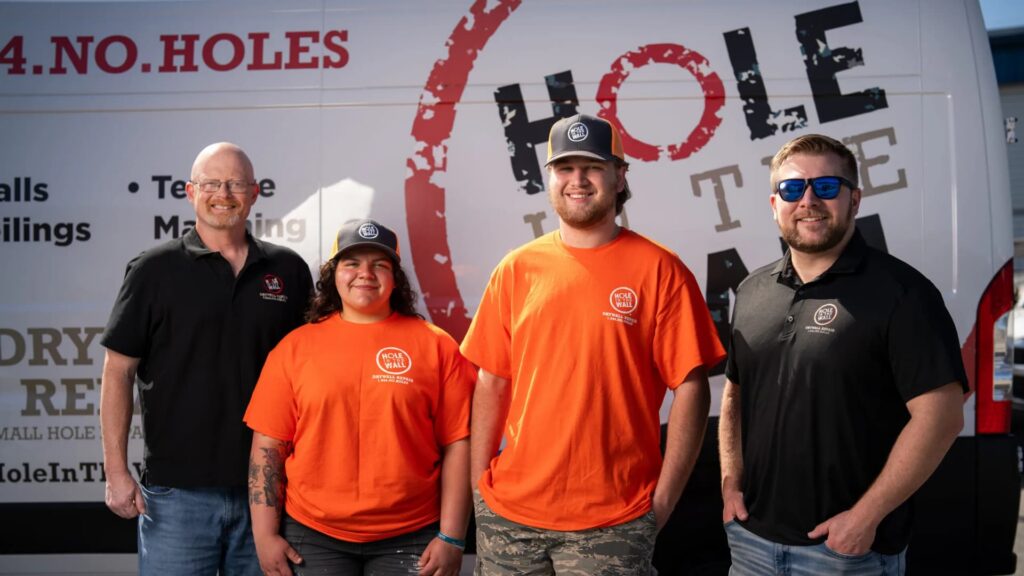
Today, Hole in the Wall describes itself as a home-based drywall repair and replacement franchise focused on delivering professional, dust-controlled repairs that blend with existing finishes. Franchisees operate from a home office within their territory and use a wrapped RAM ProMaster or similar van, outfitted to brand standards, to serve customers on-site.
The model emphasizes a simple but specialized scope: drywall repair and replacement for walls and ceilings, including backing, mudding, sanding, and texture matching after damage, wear, or water events. While the core services are technical, the owner is positioned as a local operator who manages technicians, handles estimates, and builds relationships with homeowners and trade partners rather than as the primary repair technician long term.
From a system perspective, the franchisor provides standardized equipment specifications, technology requirements, marketing frameworks, and training programs. Franchisees are required to use designated software systems for CRM and scheduling and to participate in system-wide and local marketing under Item 11 and Item 9 of the FDD. For candidates, the current franchise offering centers on home-based service territories in multiple U.S. states, with unit counts and geography disclosed in Item 20.
What Services Does a Hole in the Wall Franchise Offer?
Hole in the Wall franchisees offer a focused set of drywall repair and replacement services, positioned as a step up from basic patch work. Owners oversee consultation and job scoping, then technicians complete the hands-on repairs in customers’ homes and commercial spaces.
Typical services include:
- Repairing drywall damage from impacts (for example, door handle holes or accidental collisions).
- Addressing water damage in ceilings and walls after leaks or flooding, including removal of compromised materials and replacement.
- Performing backing, taping, mudding, and sanding to create a stable, smooth surface.
- Matching textures such as orange peel, knockdown, or other finishes so repairs blend with existing surfaces.
- Coordinating painting or final finish work when included in the scope, often in coordination with other trade partners.
The brand positions itself as “we repair, not patch,” emphasizing fully blended repairs and clean job sites. In practice, this means technicians are expected to use dust-control methods and protect the work area, while the owner ensures jobs adhere to the brand’s standards for cleanliness and finish quality.
Because licensing rules vary, the FDD notes that in some states a contractor or handyman license may be required to perform drywall work, and franchisees are responsible for understanding and complying with local requirements. Candidates should confirm specific service permissions and licensing obligations directly with the brand and with local authorities before moving forward.
Hole in the Wall Franchise Review: What Does a Hole in the Wall Franchise Cost?
One of the most common questions in any Hole in the Wall franchise review is what it actually costs to get started.
According to Item 7 of the 2026 FDD, the estimated total initial investment to open a single Hole in the Wall franchise ranges from approximately 87,000 to 132,800. This range includes the 59,500 franchise fee, a 7,500 launch support fee, equipment and technology, a wrapped vehicle, initial marketing, insurance, professional fees, and additional funds for the first three months of operations.
The franchisor also offers a Multi-Unit Development Agreement (MUDA) for two to five units, with additional upfront franchise fees for each additional unit and a higher total estimated initial investment of approximately 128,000 to 277,800.
These figures reflect startup and early operating needs only and are not a representation of financial performance or outcomes.
Estimated Initial Investment (Single Unit).
| Type of Expenditure | Low* | High* |
|---|---|---|
| Initial Franchise Fee* | 59,500 | 59,500 |
| Launch Support Fee* | 7,500 | 7,500 |
| Rent, Utilities, Leasehold Improvements* | 200 | 4,100 |
| Market Introduction Program* | 3,000 | 6,000 |
| Furniture, Fixtures, Equipment* | 0 | 1,200 |
| Computer Systems* | 500 | 1,500 |
| Insurance – Initial Premiums* | 500 | 1,500 |
| Vehicle* | 2,000 | 10,000 |
| Signage* | 0 | 1,500 |
| Office Expenses* | 500 | 1,000 |
| Inventory* | 500 | 2,000 |
| Licenses and Permits* | 100 | 500 |
| Dues and Subscriptions* | 400 | 500 |
| Professional Fees* | 300 | 2,000 |
| Travel, Lodging, Meals for Initial Training* | 3,000 | 5,000 |
| Additional Funds – First 3 Months* | 9,000 | 30,000 |
| Total Estimated Initial Investment* | 87,000 | 132,800 |
Estimated Initial Investment (Multi-Unit Development Agreement, 2–5 Units).
| Type of Expenditure | Low* | High* |
|---|---|---|
| First Franchise (from table above)* | 87,000 | 132,800 |
| Additional Initial Franchise Fees (2–5 units)* | 40,000 | 140,000 |
| Business Planning and Miscellaneous Expenses* | 1,000 | 5,000 |
| Total Estimated Initial Investment (MUDA)* | 128,000 | 277,800 |
These investment figures cover startup and early operating needs and are not a guarantee of sales, profit, or performance. Multi‑unit candidates should review the Multi‑Unit Development Agreement and confirm fee and territory details directly with the franchisor and a qualified advisor.
These figures reflect startup and early operating needs only. They do not indicate financial performance or outcomes.
What Ongoing Fees Does a Hole in the Wall Franchise Charge?
A complete Hole in the Wall franchise review also needs to explain how ongoing fees are structured once the business is open.
Hole in the Wall’s ongoing fee structure includes a percentage-of-revenue royalty with minimum thresholds, a marketing fund contribution, required local marketing spending, technology fees, and other periodic charges. These obligations should be evaluated in the context of the full business model rather than as stand-alone numbers.
Key Ongoing Fees.
Because royalties and marketing spend are tied to gross sales, candidates should review the definitions of “Gross Sales” in the franchise agreement and understand how these fees would behave across different revenue scenarios. Working with an experienced FBA franchise consultant can help you compare fee structures across brands using consistent assumptions while staying within FDD parameters.
How Does the Hole in the Wall Franchise Model Work Day to Day?
Hole in the Wall operates as a home-based, mobile business with no retail storefront and no inventory warehouse, similar in broad structure to many home-services franchises. Owners work from a home office, coordinate technicians with a wrapped van, and meet customers at their properties, using the franchisor’s systems to manage workflow and quality.
The operating model includes:
- A home office setup for scheduling, estimates, invoicing, and marketing activity.
- A branded van outfitted with required tools, materials, and protective equipment, maintained to brand standards.
- A required CRM and software suite for intake, scheduling, and reporting, along with email and phone systems for customer communication.
- A defined service process, including inspection, repair planning, execution, cleanup, and follow-up.
A Typical Owner-Operator’s Day.
The daily rhythm for a Hole in the Wall owner blends office work, field visibility, and relationship-building:
- Morning: Review the CRM for new leads from digital marketing and referrals, confirm the day’s schedule, and assign jobs to technicians based on geography and complexity.
- Consultations: Conduct or oversee estimates for new jobs, either on-site or virtually, documenting damage, explaining the repair process, and generating proposals under the brand’s standards.
- Midday: Check on active jobs, respond to technician questions, and monitor quality and timing; handle customer updates and any scope clarifications.
- Afternoon: Finalize invoices for completed work, follow up on outstanding proposals, and review daily metrics such as completed jobs, average ticket, and customer feedback.
- Business development: Set aside time weekly to connect with property managers, real estate professionals, and trade partners to maintain referral relationships.
The franchise agreement requires a designated Principal Executive who completes training and is responsible for ensuring the business follows the system. Owners are not required to perform on-premises supervision themselves, but the franchisor recommends owner involvement and expects the general manager (owner or hired) to complete training.

What Training, Support, and Territory Structure Does Hole in the Wall Provide?
No Hole in the Wall franchise review would be complete without covering how the brand trains and supports new owners and how territories are defined.
Hole in the Wall combines structured initial training, ongoing support, and exclusive territories to give new owners a defined path from signing to launch. The system is designed so owners can focus on running the business while technicians and tools execute the drywall work.
Training and Support.
New franchisees receive:
- Pre-Training: Orientation to the brand, review of brand guidelines, introduction to CRM basics, and technology setup.
- School of Rock Drywall Academy: A two-week in-house training at headquarters in Orlando. Week one focuses on admin and business operations for owners and managers; technicians ride along with HQ teams and observe live jobs. Week two is more hands-on, covering drywall repair techniques, texture matching, and jobsite standards.
- Online Training Portal: Access to an app-based portal with over 300 topics and 50+ video tutorials covering technical and operational content, available for ongoing learning.
- Optional On-Site Training: In some cases, additional on-site technical training may be available for franchise locations.
- Ongoing Support: Franchisees can contact corporate for help, access a network of other owners, and receive guidance on operations and marketing as the system evolves.
On the marketing side, the brand uses an in-house marketing team to run digital campaigns and support local promotional efforts, while franchisees are responsible for executing approved marketing in their markets and meeting local spend requirements.
Territory Structure.
Hole in the Wall territories are defined by geographic boundaries and population, with the FDD describing territories as exclusive for the franchised drywall repair services. The franchisor typically defines territories around a population base, using zip codes or similar geographic units.
The FDD notes that while franchisees receive territorial rights, the franchisor retains certain rights related to other brands, products, or channels. Multi-unit development is available through a MUDA, which sets a development schedule for additional units and requires additional fees.
Territory rights, renewal terms, development schedules, and expansion options should always be reviewed with a qualified franchise attorney. To compare territory structures across home-services brands, connecting with an FBA franchise consultant can provide perspective.
What Is the Ideal Owner Profile for a Hole in the Wall Franchise?
A useful Hole in the Wall franchise review has to address fit as directly as it addresses cost.
Hole in the Wall is designed for owners who want to run a process-driven, technician-based home services business and are comfortable with sales, team leadership, and local relationship-building. The brand is explicit that prior drywall experience is not required, but a willingness to be hands-on operationally — especially at launch — is important.
Who Tends to Be a Good Fit?
The brand’s ideal candidate profile highlights several traits that tend to align well:
- Business and operations background: Experience in corporate operations, logistics, management, or service roles where process and metrics matter.
- Entrepreneurial drive: A desire to build something of their own, manage a team, and grow into multi-van or multi-unit operations over time.
- Relationship skills: Comfort working with homeowners, property managers, Realtors, and trade partners to secure and maintain referral relationships.
- Hands-on at launch: Willingness to be deeply involved in scheduling, estimates, and quality checks during the early months, even if the long-term goal is a more strategic role.
- Financial readiness: The ability to fund the required initial investment and support the business through the early operating period described in Item 7.
A secondary candidate type is the experienced tradesperson (for example, painter or handyman) who wants to move from “being the technician” to building a branded, systematized drywall repair business with dedicated technicians.
When Might Hole in the Wall Not Be the Right Fit?
The model may be less suited for candidates who:
- Want a passive or largely hands-off investment from day one.
- Prefer full-time trade work and do not enjoy sales, management, or networking.
- Are looking for a retail or showroom environment with walk-in traffic.
- Are uncomfortable with hiring, supervising, and retaining technicians in a field-based service business.
How Does Hole in the Wall Compare to Similar Home-Services Franchises?
Context matters in any Hole in the Wall franchise review, and that means looking at how the brand sits relative to other home-services concepts.
Hole in the Wall occupies a defined niche within home-services franchising — a drywall repair and replacement brand focused on repairs rather than full-scale remodels or broad handyman services. That positioning changes the comparison when you place it alongside general handyman, painting, or restoration brands.
Key Structural Differences.
These structural differences do not make Hole in the Wall inherently “better” than other concepts, but they do change how the business operates and who thrives in it.
Frequently Asked Questions About the Hole in the Wall Franchise.
Is Hole in the Wall a home‑based franchise?
Yes. Hole in the Wall is structured as a home‑based franchise where owners operate from a home office and use a branded van and technicians to serve clients in their territory. A retail storefront is not part of the standard launch model, although owners must still comply with local zoning and business regulations.
What is the total investment to open a Hole in the Wall franchise?
The 2026 FDD indicates an estimated initial investment range of approximately 87,000 to 132,800 for a single Hole in the Wall franchise, including the franchise fee, launch support, vehicle, technology, marketing, and three months of additional funds. For a two-to-five-unit Multi-Unit Development Agreement, the estimated range is about 128,000 to 277,800. Candidates should confirm current figures in the most recent FDD and review them with a qualified advisor.
Do I need drywall or construction experience to own a Hole in the Wall franchise?
No prior drywall or construction experience is required, because the model is built around training owners and technicians through the School of Rock academy and an extensive online training portal. Training and systems are designed to teach owners how to manage operations, technicians, and client experience, so backgrounds in management, sales, or operations can be a strong foundation.
What does a Hole in the Wall owner actually do each day?
A typical day involves reviewing scheduled estimates and projects in the CRM, coordinating technicians, visiting properties for estimates or quality checks, and managing customer communication. Owners also handle invoicing, monitor performance metrics, and invest time in local networking with real estate professionals, property managers, and trade partners.
What kind of training and support does Hole in the Wall provide?
Hole in the Wall provides a blended training program that includes pre-training, a two-week in-person training at the School of Rock Drywall Academy, and ongoing access to an online training portal. After launch, support includes marketing assistance from an in-house team, operational guidance, and access to a franchisee community for peer learning and problem-solving.
Does the Hole in the Wall FDD include financial performance information?
Yes. The 2026 Hole in the Wall FDD includes an Item 19 Financial Performance Representation that provides certain historical financial information about outlets in the system. Candidates should review Item 19 directly with their legal and financial advisors to understand the context and limitations of the data. The franchisor may provide financial performance information in Item 19 of the FDD; consult the document with a qualified advisor.
Is the Hole in the Wall franchise right for you?
Hole in the Wall offers a home‑based entry point into a drywall repair niche within the broader home‑services market, with technician‑driven operations and defined support from a relatively young franchisor. The model tends to suit candidates who are comfortable managing technicians, handling local sales and relationships, and running a process-driven service business from a home base.
Questions to Ask During Your Due Diligence.
As you decide whether Hole in the Wall is a good fit, consider asking the franchisor and current franchisees questions such as:
- Which territories are currently available in your preferred markets, and how are demographic and boundary criteria defined?
- What are the key steps and timelines between signing the agreement and completing initial training, launch support, and opening your first territory?
- How do marketing programs and recommended channels support lead flow, and what level of self‑generated business development is expected from the owner?
- How does technician recruiting and retention work in markets similar to yours, and what support is available from corporate?
- What are the renewal, transfer, and termination terms in the current Franchise Agreement and FDD, including any state-specific addenda?
- Can you speak with existing franchise owners in comparable territories to understand how the model works in practice over multiple seasons?
From there, you can compare Hole in the Wall with other home‑services and home‑based concepts in terms of cost structure, owner role, territory approach, and support model to see which path aligns best with your goals, risk tolerance, and preferred way of working.
Is the Hole in the Wall Franchise the Right Fit for You?
Hole in the Wall generally suits aspiring owners who want to lead a focused home‑services business in a practical, repair‑driven niche — not manage a passive investment or perform all trade work themselves. Before moving forward, it helps to ask yourself a few questions:
- Are you comfortable with hands‑on early involvement in sales, client consultations, scheduling, and technician coordination?
- Do the startup costs and ongoing fees align with your capital, financing options, and risk tolerance based on the FDD ranges?
- Are strong territories available in your target market, and does the local housing stock and commercial mix support sustained drywall repair demand?
- How does this opportunity compare with other franchises you are considering in terms of cost, owner role, and support structure?
If this Hole in the Wall franchise review helped clarify what the opportunity looks like, your next move is to take the conversation further with the brand and an experienced advisor.