If you are already looking at the Junk King franchise and want more than a sales brochure, this guide is designed to show you what the opportunity actually looks like from a prospective owner’s perspective. It walks through what it costs to get started, how the truck‑based, eco‑focused model works in real life, and the kind of day‑to‑day responsibilities you can expect once your doors are open.
Junk King combines branded trucks, a local warehouse, and a national support platform—including a call center, proprietary routing and scheduling software, and structured training—to help franchisees serve residential, commercial, and government customers. Instead of building a junk‑removal business from scratch, owners plug into an existing system that emphasizes recycling and donations, standardized service processes, and defined protected territories.
Throughout this article, you will see how the investment range, territory structure, training, and owner role fit together, along with practical questions to ask during due diligence. The goal is not to persuade you that Junk King is the right franchise, but to give you enough detail to decide whether this specific model matches your goals, skills, and comfort with running a crew‑driven, service‑based business.
This article is sponsored by Junk King and was created in partnership with the brand to provide accurate, compliance-safe information about its business model and franchise opportunity. Nothing in this article should be considered legal, financial, or tax advice. Prospective franchisees should always review the most recent Franchise Disclosure Document (FDD) with qualified advisors before making an investment decision.
Key Facts at a Glance.
- Founded year: 2005 (San Carlos, California)
- Headquarters: Waco, Texas (Junk King SPV LLC principal address)
- Unit count / footprint: 170+ franchised locations in the United States as of the latest available disclosures
- Business model: Mobile junk removal with 18‑cubic‑yard trucks plus warehouse/light‑industrial space for sorting and recycling
- Owner profile snapshot: Executive‑style owner who leads crews, manages operations, and builds local relationships, rather than doing all hauling personally
- Training highlight: Multi‑phase training including corporate sessions, online modules, and in‑territory support
- Territory note: Fully protected territories typically based on population ranges in the hundreds of thousands
Who owns Junk King, and how did the brand get started?
Junk King began in 2005 in San Carlos, California, with a focus on professional junk removal and strong recycling practices, and has since grown into one of the larger junk‑removal systems in North America. Today, U.S. franchise operations are managed by Junk King SPV LLC, a Delaware company based in Waco, Texas, and Junk King operates as part of Neighborly’s family of home‑service brands.
Over the years, franchises were originally granted by predecessor entities before being transferred to the current franchisor, which now oversees existing and new franchise agreements and the associated trademarks in the U.S. Being under the Neighborly umbrella means Junk King benefits from shared vendor programs, cross‑brand referrals, and centralized training and technology resources that support multiple service brands.
For someone evaluating the franchise today, this history means you are looking at a brand with both a founder‑driven origin story and a more mature, systems‑driven platform in its current form. It is still important to confirm any recent leadership or structural changes directly with the franchisor, as corporate structures can evolve over time.
How much does it cost to open a Junk King franchise?
If you already like the concept and are trying to understand the capital side, current disclosure materials indicate that the estimated initial investment for a standard Junk King territory typically ranges from about 125,400 USD to 300,000 USD. That range includes the franchise fee, at least one truck, warehouse and office setup, and several months of working capital.
Junk King Franchise Startup Costs & Fees.
| Type of Expenditure | Low Estimate* | High Estimate* |
|---|---|---|
| Initial Franchise Fee* | $55,000 | $77,000 |
| Travel & Living Expenses While Training* | $1,200 | $5,000 |
| Inventory & Supplies* | $800 | $1,500 |
| Fixtures, Furniture & Equipment* | $0 | $3,000 |
| Signage* | $500 | $1,000 |
| Vehicles* | $19,200 | $100,000 |
| Office & Warehouse Lease* | $1,500 | $7,000 |
| Professional Fees* | $0 | $3,000 |
| Security Deposits, Utility Deposits, Business Licenses & Other Prepaid Expenses* | $2,200 | $5,000 |
| Additional Funds — First 3 Months* | $45,000 | $97,500 |
| TOTAL* | $125,400 | $300,000 |
Junk King Franchise Ongoing Fees & Support.
| Category | Rate / Estimate* | Notes |
|---|---|---|
| Royalty Fee* | 8% of Gross Sales | Standard ongoing license fee; may be subject to minimum thresholds |
| Brand / Marketing Fund* | 2% of Gross Sales | National MAP Fund; or a set monthly minimum, whichever is greater |
| Local Marketing Spend* | Not disclosed | Minimum spend required based on prior‑year sales; confirm exact % with franchisor |
| Technology / Software* | $159/month + | Monthly JunkWare platform fee; add‑ons may include QuickBooks, email, and analytics tools |
| Call Center Fee* | Not disclosed | Percentage of Gross Sales; covers national inbound scheduling and national account handling |
| Other Periodic Fees* | Not disclosed | May include convention fees, transfer fees, audit costs, and other items per the fee schedule |
Important context: These figures reflect startup and early operating needs only. They do not indicate financial performance or outcomes.
What tends to move the total up or down?
Once you are past the brochure level and building a real plan, the main drivers that push your total investment toward the high or low end of the range are territory choice, local costs, and your growth pace.
Typical variables include:
- Real estate and warehouse space: Market rates for 1,200–2,500+ square feet of light‑industrial space differ widely by city and can be a major swing factor.
- Local labor costs: Wages and benefits for drivers and crew members may vary significantly between markets; higher labor markets often require more conservative working‑capital planning.
- Trucks and equipment choices: Whether you buy or finance your first truck, and when you add a second truck or begin a dumpster program, can change both your launch budget and ongoing cash flow.
- Marketing strategy: The system sets minimums, but many owners choose to go above them in competitive or large territories to accelerate awareness and referrals.
- Working‑capital buffer: Some candidates prefer to model more than three months of additional cash to feel comfortable with the ramp‑up curve in their specific market.
What is Junk King’s business model, and what does day-to-day operations look like?
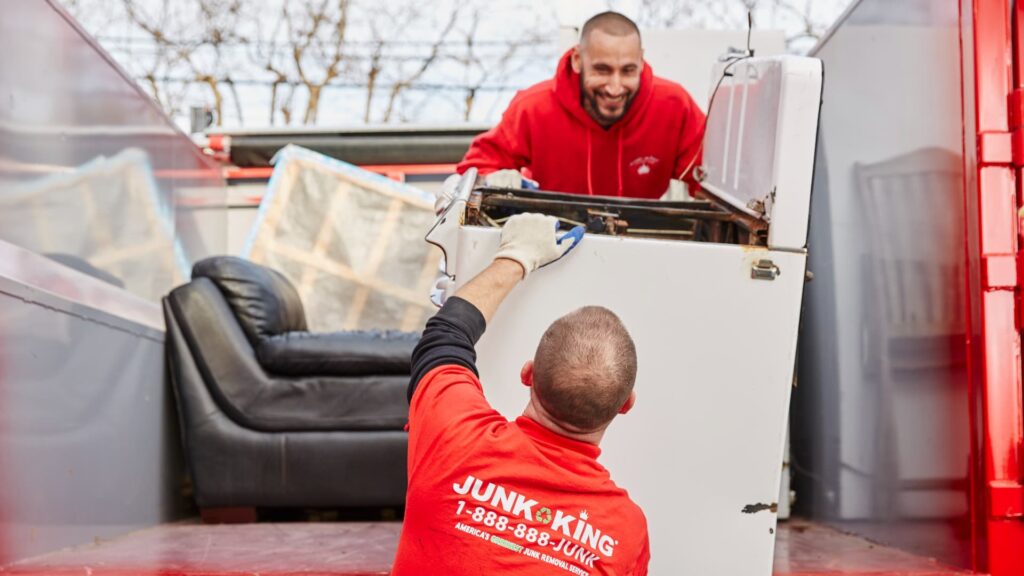
If you already know you want to be in junk removal, the main operational question is how structured and diversified the model is. Junk King uses a truck‑based, warehouse‑supported model that serves multiple customer types—homeowners, businesses, and public‑sector clients—while emphasizing recycling and donations.
The core pieces include:
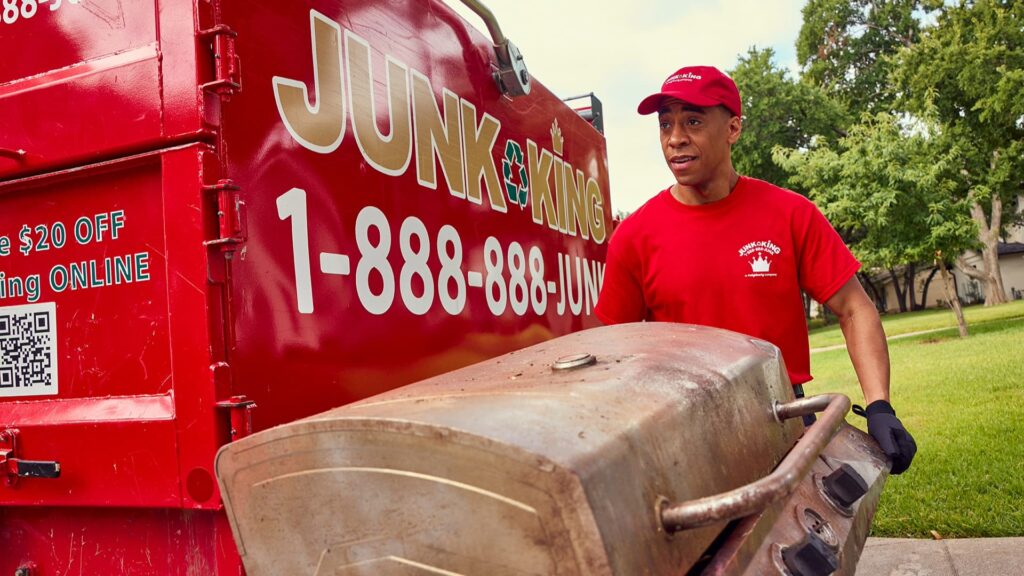
- Full‑service junk removal: Crews in branded 18‑cubic‑yard trucks handle furniture, appliances, yard debris, construction material, and more, often booked for same‑day or next‑day service.
- Dumpster rentals and bag programs: In many markets, owners can add dumpster rentals and a bag‑pickup option to serve DIY customers and contractors who want self‑service over a few days.
- Recycling and donations: A significant portion of each truckload is sorted at the warehouse for recycling, reuse, or donation, which supports both community positioning and landfill‑reduction goals.
- Call center and technology: A national call center books jobs 7 days a week and feeds them into the proprietary software, which manages schedules, routes, GPS tracking, and integration with accounting tools.
In practice, that means you are running a local service business with crews and trucks, but with centralized help on lead intake, routing software, and brand‑level marketing.
What does a typical day look like for an owner-operator?
Most interested candidates want a picture of daily life before they commit. Junk King is positioned as an “executive‑ownership” model, meaning you lead the business rather than doing all the physical work yourself, especially once you have an established crew
A typical day for an engaged owner might include:
- Early morning:
- Mid‑day:
- Visit key commercial or referral partners—realtors, property managers, contractors, facility managers—to keep relationships warm and explore new projects.
- Check the warehouse flow to be sure crews are sorting recyclables and donation items correctly and that loads are staged for recycling centers and donation partners.
- Afternoon and close‑of‑day:
What training, support, and technology does the franchisor provide?
Candidates who are already engaged with the brand often ask how much real help they will get before and after opening. Junk King’s training and support are positioned as a key part of the model, with a mix of classroom, online, and field‑based components, plus the Neighborly support framework behind the scenes.
Junk King Franchise Support & Systems Overview.
| Support Area | What It Includes |
|---|---|
| Initial Training | – At least one week at corporate headquarters – Additional in‑territory training before and around opening – Virtual pre‑work modules to complete before arrival |
| Ongoing Training | – Online learning modules – Regional owner meetings – Annual franchise convention – System update communications throughout the year |
| Field Support | – Dedicated franchise business coach – Regular performance check‑ins (calls and on‑site visits) – KPI tracking and operational troubleshooting |
| Manuals / SOPs | – Full Operations Manual – Service delivery and recycling protocols – Safety, hiring, and customer‑service standards |
| Technology Platform | – Proprietary JunkWare software – Scheduling, GPS tracking, job notes, and invoicing – QuickBooks Online integration – Mobile access for field crews |
| Marketing Support | – National call center (open 365 days/year) – Brand‑wide digital and traditional advertising – Local marketing templates and co‑op programs – National account management |
For someone comparing franchise options, the big takeaway is that you are not expected to invent a junk‑removal business from scratch. Instead, you are plugging into an existing operating system, with specific responsibilities for execution in your market.
What should you confirm during due diligence?
Once you are far enough along to have a disclosure document in hand, your focus shifts to making sure the written model aligns with your expectations and risk tolerance. Due diligence is where you validate the training, support, and cost story you have heard in presentations.
Useful questions to ask at this stage include:
- How exactly is the initial training structured right now (days on site, virtual modules, shadowing opportunities), and how soon before opening does it begin?
- What does the first year of support look like in practice—how often do you speak with your coach, and what kinds of metrics do they track with you?
- Which software tools are mandatory, which are optional, and what is a realistic monthly technology budget once everything is in place?
- How does the franchisor handle national accounts within your protected territory, and how are those jobs assigned and billed?
- What assumptions sit behind the cost estimates for working capital and marketing, and how do existing owners say those assumptions held up once they were operating?
- What territory performance expectations, if any, exist, and how are they measured over time?
- Is financial performance information available in the current document, and how does the franchisor recommend you use it when building your own plan? The franchisor may provide financial performance information in Item 19 of the FDD; consult the document with a qualified advisor.
How do territories, real estate, and equipment requirements typically work?
If you are serious about opening a Junk King franchise, you will need a clear picture of your territory boundaries, your facility needs, and the minimum fleet and equipment requirements. These three areas strongly influence your overhead and growth path.
What real estate profile is typical?
Most franchisees operate from a warehouse or light‑industrial unit that can accommodate trucks, sorting operations, and an office area. Junk King’s materials and third‑party write‑ups commonly reference spaces around 2,000 square feet, with flexibility depending on your market and growth plan.
Typical site features include:
- Sufficient yard or bay‑door access for at least one large branded truck, with room to add more.
- Indoor space for unloading and sorting items into recycling, donation, and disposal categories safely and efficiently.
- A modest office section for computers, phones, records, and staff meetings.
You will work with local brokers and landlords to secure a lease that meets the brand’s guidelines. The franchisor often provides site criteria and may review proposed locations, but final lease terms are between you and the property owner.
How does territory protection work?
From a candidate’s perspective, what matters most is whether you have clear boundaries and confidence that you are not competing with another franchisee under the same brand for the same customers. Junk King advertises fully protected market territories, generally defined by population—often in the 450,000–650,000 range per territory on public franchise pages.
The franchise agreement and disclosure document explain:
- How territories are drawn (by ZIP codes, counties, or other mapping).
- What “protected” means in terms of other franchisees and corporate units.
- How national accounts and special‑program jobs may cross territorial lines and how credit for those jobs works.
Because territory terms differ among systems, ask the development team to walk you through a sample territory map and to show you exactly how your area would be defined if you sign.
What equipment or vehicles are commonly required?
For someone ready to dig into operational details, the starting point is at least one approved junk‑removal truck plus basic warehouse, safety, and office equipment. Over time, most owners add trucks or a dumpster program as demand grows.
Common requirements include:
- A branded 18‑cubic‑yard truck that meets the franchisor’s specifications, with financing or cash purchase options.
- Lifting and loading tools such as dollies, hand trucks, and basic power tools.
- Safety gear including gloves, masks, high‑visibility vests, and appropriate footwear.
- Warehouse equipment such as shelving, containers, and pallet jacks to support efficient sorting and storage.
- Office technology including computers, printers, and mobile devices that run the Junk King software.
If you decide to expand into dumpsters, there will be separate equipment and investment considerations, which you should review in detail with the franchisor and in the cost tables.
Who is the ideal Junk King owner, and what time commitment is typical?
People who get serious about this franchise usually want to confirm whether their background and work style actually match what the system rewards. Junk King describes its model as suitable for owners who want to manage teams and grow a scalable operation, not for those looking for a solo, part‑time side business.
You may be a strong fit if you:
- Enjoy leading and developing people and are willing to spend time on hiring, training, and coaching.
- Are comfortable selling and networking—especially with realtors, property managers, contractors, and community partners.
- Prefer structured systems and are willing to follow documented processes around pricing, technology, branding, and service.
- Like the idea of an environmentally focused business that diverts a significant share of waste from landfills through recycling and donations.
- Can commit full‑time effort, particularly in the first years, to getting operations, culture, and local reputation where they need to be.
You may want to proceed cautiously if you:
- Strongly prefer a home‑based, desk‑only role with minimal field interaction.
- Dislike supervising hourly staff or addressing performance and scheduling issues.
- Want full creative control over brand, pricing, and systems instead of operating within a defined framework.
- Are looking primarily for a low‑involvement investment without a clear plan to hire management to take on your responsibilities.
How does Junk King compare to similar franchise options?
Once you are interested enough to compare brands, you will be weighing Junk King against other junk‑removal and service franchises on factors like diversification, support, and owner role. Junk King generally positions itself as a “green,” multi‑segment, technology‑supported brand backed by Neighborly.
Qualitative comparison points include:
- Service mix: Junk King offers full‑service hauling, dumpster options, and a bag program in many markets, while some competitors focus on one channel.
- Customer segments: The model actively targets residential, B2B, and government customers, not just homeowners, which can diversify your lead flow.
- Support infrastructure: The combination of a national call center, proprietary software, and Neighborly coaching and vendor programs may feel more robust than smaller, stand‑alone systems.
- Brand positioning: Emphasis on recycling and donation gives owners a clear story to tell in markets where environmental responsibility matters.
- Owner role: The system is designed for hands‑on leadership and growth, which may appeal to career changers from management or sales roles who do not want to perform all field labor themselves.
FAQ about the Junk King franchise.
1. How long does it take to get a Junk King franchise open once I sign?
Many candidates ask how quickly they can realistically launch after signing. Junk King’s public materials suggest that, depending on site selection, training timing, and truck availability, it can take roughly 5–12 weeks to get a new franchise up and running, though actual timelines vary by market and readiness.
2. What is included in the initial investment for a Junk King franchise?
Prospects often want a simple breakdown of where their money goes. The estimated initial investment range covers the franchise fee, at least one truck and vehicle up‑fit, warehouse and office setup, initial supplies and uniforms, training travel, licenses and deposits, and several months of working capital to cover early operating expenses.
3. How much help does Junk King provide with marketing and finding customers?
Most serious candidates want to know they will not be on their own for marketing. Junk King supports owners through a national call center that answers inquiries and books jobs, participation in a brand‑wide advertising fund, access to digital and traditional marketing programs, and guidance on local marketing requirements and best practices, while still expecting franchisees to actively build relationships in their own communities.
4. Do I need waste‑management or trucking experience to qualify?
Many people looking at Junk King are career changers rather than industry veterans. The brand does not require previous junk‑removal or waste‑management experience; instead, it looks for owners who can lead teams, follow systems, and communicate well with customers and partners. Training, online modules, and field support are designed to teach the technical parts of the business.
5. What kind of ongoing support will I receive after my Junk King franchise is open?
Candidates who are already in conversations with the brand usually ask about post‑launch support. After opening, owners are supported by a designated Sure Start consultant or similar role, franchise business coaches, online training resources, an owner hotline, on‑site visits, and annual and regional meetings, all layered on top of the call‑center and technology support.
6. How “green” is the Junk King model in everyday practice?
Environmentally minded buyers often want specifics on the recycling claim. Junk King positions itself as a green junk‑removal brand, with franchisees sorting a substantial portion of each truckload for recycling, reuse, or donation to local charities, resale outlets, and specialized recyclers, rather than sending everything directly to landfill. Exact diversion percentages can vary by territory and local facilities, so this is a useful question to raise when you speak with current owners.
Is Junk King the right fit for you?
If you are reading this because you already like the idea of an eco‑focused, truck‑based service business, the final question is whether the day‑to‑day work, required investment, and owner role match your goals and strengths. Junk King can be a fit for people who want to actively run a local operation with national backing, but it is not a passive or part‑time venture.
It may be a good fit if you:
- Want to lead a team, spend time in the field, and build a visible local presence.
- Are comfortable talking with homeowners, property managers, contractors, and community partners on a regular basis.
- Like having a defined playbook for branding, pricing, and operations, and see yourself executing that playbook rather than reinventing everything.
- Care about recycling and donation and want a business that can talk credibly about environmental responsibility.
- Are ready to commit full‑time energy to launching and growing the franchise, especially in the first few years.
You may want to be cautious if you:
- Prefer a business with no physical operations, trucks, or warehouse and would rather stay behind a desk.
- Do not enjoy managing hourly staff or dealing with scheduling, training, and performance issues.
- Strongly prefer to build your own independent brand, pricing, and processes rather than operate within a franchise system.
- Are looking primarily for a low‑involvement investment without a clear plan to hire management to take on your responsibilities.
If you want to go deeper, the most valuable thing you can do now is review your owner profile honestly, compare this model with similar options, and build a structured checklist before you make any commitments.